Electra Protocol is the perfect ecosystem for payments, DeFi, NFTs, gaming, supply chain management, Web3, and more. Crafted to become credibly neutral public infrastructure.
As seen in










Empower Your Financial & Creative Future
Mainnet: LIVE
Launch: January 1, 2021
Native Currency: XEP

How to Buy XEP
You can buy XEP on one of the exchanges. You can also buy Wrapped XEP (WXEP tokens) on PancakeSwap.
How to Store XEP WALLETS
After obtaining native XEP coins, transfer them to a XEP Wallet (recommended). If you purchased Wrapped XEP (WXEP tokens), you can either store them in a WXEP Wallet or convert them into native XEP coins.
For security reasons, it is recommended that you do not leave your purchased XEP coins on centralized exchanges. Instead, store your XEPs using one of the following wallet types:
- Desktop computer wallets (compatible with Windows, MacOS, and Linux)
- Smartphone wallets (compatible with Android and iOS)
- Hardware wallets (such as Ledger Nano)
XEP Desktop wallets store a full copy of the Electra Protocol blockchain, which enables you to receive staking rewards if you keep your wallet online and unlocked (recommended). In contrast, smartphone XEP wallets, WXEP wallets, and hardware wallets cannot stake because they do not maintain a complete blockchain copy.
Shaping the Future FUTURE

Electra Protocol is the evolution of crypto: a fully decentralized, open source, and crowdsourced ecosystem for instant transactions which did not conduct any public funding, like Bitcoin.
- Send payments within 1 to 2 seconds worldwide.
- Pay the equivalent of ~$0.0000002 USD per transaction.
- Receive rewards for staking or providing liquidity.
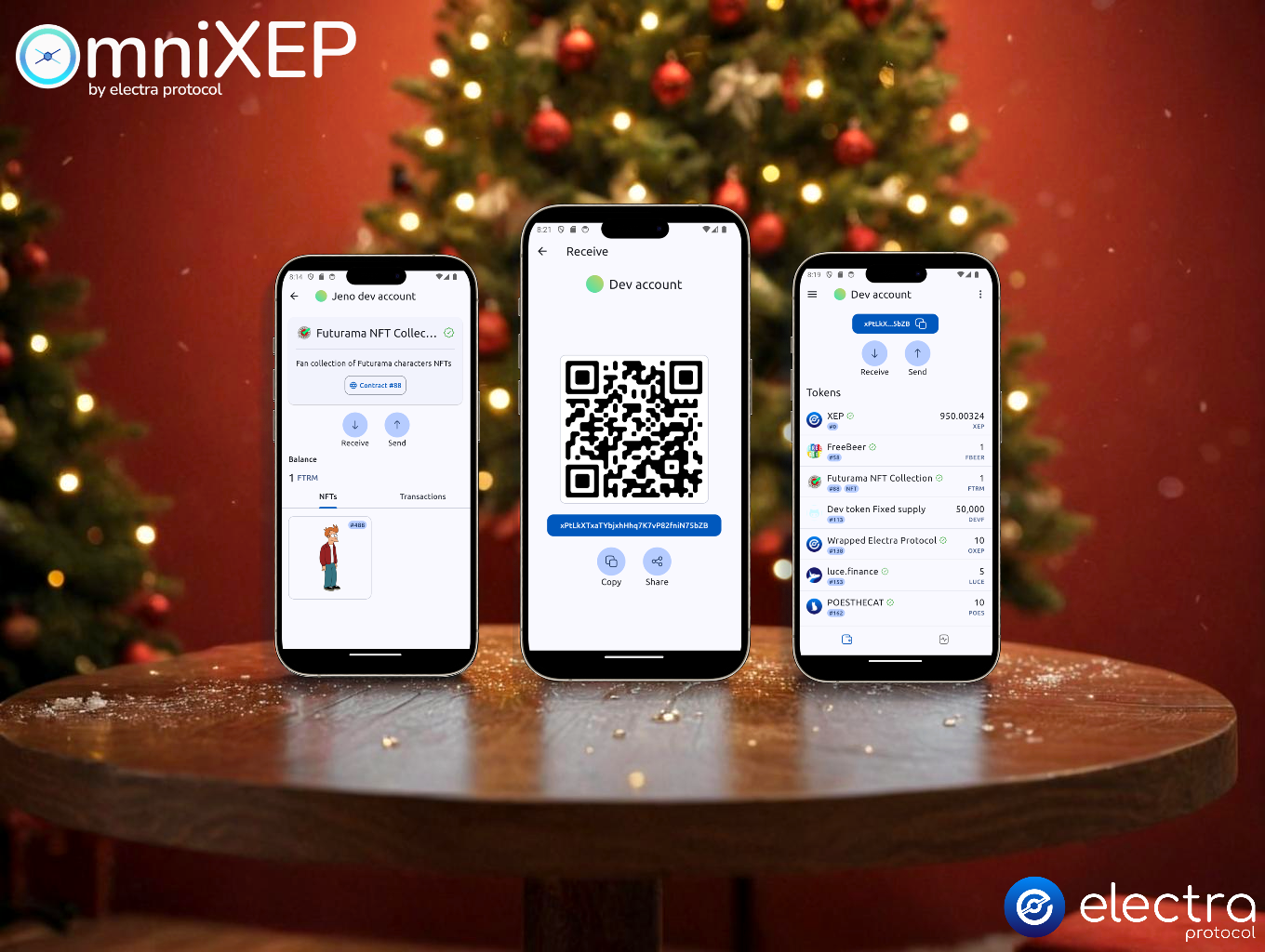
- Create tokens and NFTs using the OmniXEP platform.
- Send and receive payments in any supported currency soon.
OPEN-SOURCE TEAM
As with Bitcoin, the development, marketing, and related work are carried out by a large community of individuals. Electra Protocol is not driven by a company and did not conduct an ICO. Electra Protocol is supported by the Electra Foundation.
COMMUNITY CONTACTS
Please consult our knowledge base for answers to frequently asked questions, or reach out to a community member for assistance.

Technical Developments ROADMAP
Electra Protocol Mainnet blockchain and XEP Block Explorer officially launched
XEP Wallets released for Windows, Apple, Linux and Raspberry Pi
XEP Wallets released for Android and iOS
Enhanced XEP Block Explorer released
Rosetta API integration released
XEP Smart Contract Wallet
Public smart contract platform planned
All-in-one XEP Wallet for holding XEP coins and Smart Contract tokens
Validator nodes planned
News and Articles BLOG


Electra Protocol: Bridging the Gap Between Blockchain and Real-World Assets
In the rapidly evolving world of blockchain technology, the Electra Protocol stands out as a...
Frequently Asked Questions FAQS
If you cannot find a satisfying answer, please do a search, browse the knowledge base, or contact community members through social media.
Electra Protocol is a fast, secure, proof-of-stake blockchain designed for enterprise-scale use. It supports instant, real-time multicurrency payments and a wide range of applications including NFTs, gaming, and supply chain tracking. Public smart contracts allow anyone to issue their own tokens on the network.
Electra Protocol is one of the fastest blockchains in the world, with global transactions completed in just 1 to 2 seconds. It can process over 1,500 transactions per second—and there are plans to increase this even further. Additionally, transaction fees are very low, costing less than US $0.01 per transaction.
Electra Protocol was designed from the ground up to meet upcoming regulation by authorities worldwide. For example, in order to comply with the Howey Test of the SEC (U.S. Securities and Exchange Commission), Electra Protocol did not conduct an Initial Coin Offering (ICO) or an Initial Exchange Offering (IEO). Also other upcoming challenges to regulation are taken into account by future solutions, such as preparing for optional KYC identification (if required by the payment parties) and AML conformity. Electra Protocol is also prepared for another aspect of possible regulation: the creators of the blockchain did not issue complementary investment stakes to insiders, which appears to be the case for many other crypto projects.
XEP is the currency symbol of the native coin belonging to the Electra Protocol blockchain. XEP is used as main currency used for transactions. XEP coins can be bought at a number of selected exchanges. The meaning of the XEP currency symbol is: X=ISO code for international, E=Electra, P=Protocol.
A transaction of XEP coins between different XEP wallets is very cheap: one transaction on the Electra Protocol blockchain costs 0.000226 XEP - around US $0.000000452 at the time of writing. Transactions from exchanges to a XEP wallet might be more expensive, as exchanges add their own fees on top.
Electra Protocol has a theoretical maximum supply of 30 billion XEP (30,000,000,000). Currently only around 18 billion XEP (18,000,000,000) are under circulation, of which around 3 billion XEP (3,000,000,000) are part of the premine for the Electra Foundation who is maintaining the project. XEP staking fees are paid until the maximum supply is reached.
WXEP is the currency symbol of wrapped XEP tokens (not coins!) running on the Binance Smart Chain. Those wrapped XEP tokens (WXEP) are offered in order to attract investors who would otherwise not know Electra Protocol. If you buy WXEP tokens on Pancakeswap you can exchange them 1:1 to XEP coins using the TXbit.io exchange.
No, you cannot stake WXEP using a XEP Desktop Wallet as XEP and WXEP are not directly interchangeable. Wrapped XEP tokens (WXEP) can instead be used to earn rewards on Pancakeswap for providing liquidity (which regular XEP coins can't). If you would like to stake using a XEP Desktop wallet, you have to convert WXEP to XEP using TXbit.io and transfer the XEP afterwards to your XEP Desktop wallet.
The rewards on Pancakeswap are flexibel, depending on the time you invest. The rewards can reach 25% APY for providing liquidity.
Smart contracts bring functionalities to blockchains. Using smart contracts anyone can program solutions ontop of Electra Protocol, as well as release their own tokens.
OmniXEP is now available, allowing users to create NTFs and Tokens. Smart-EP is scheduled to release at a later time. The programming language used with Smart-EP will be Solidity, which is the programming language of smart contracts of the Ethereum blockchain.
Smart contracts are powerful, because they enable to create programmable money functionality, such as to release own currencies ontop of Electra Protocol. In combination with realtime transactions and near zero gas fees smart contracts of Electra Protocol have the potential to become an innovation driver for finance and fields such as NFTs, gaming, supply chain tracking, and beyond.